
Assembling Freedom #13
Bitcoin Mining Insights Newsletter

January 14, 2026
Be sure to sign and share the petition to pardon Samourai at change.org/billandkeonne
Welcome to this special edition of the Bitcoin Mining Insights Newsletter, where we dissect the latest episode of POD256 (Episode 101: "HydraPool, HashDash, and the Telehash Playbook: Open-Sourcing Bitcoin Mining"). Hosted by Tyler, Skot, Rod and eco, with guest developer d++, this episode dives into the nuts and bolts of open-sourcing the Bitcoin mining stack. Recorded on January 14, 2026, the discussion emphasizes practical implementations in Rust, real-time dashboards, fundraiser integrations, and the push against proprietary monopolies. For our technical audience—miners, developers, and hardware enthusiasts—we'll break down key topics into dedicated sections. Each section explores the topic's importance, extrapolations from the dialogue, and broader implications, drawing on technical details like protocol integrations, scalability testing, and ecosystem interoperability to provide actionable insights.
HydraPool: The Rust-Based Open-Source Mining Pool Stack
HydraPool represents a critical step toward democratizing Bitcoin mining by providing an open-source alternative to proprietary pool software like Bitmain’s Antpool backed FPPS monopoly or other centralized entities. Built in Rust for its memory safety, concurrency advantages, and performance in high-throughput environments, HydraPool draws inspiration from established pools like CKPool (for efficient share processing) and P2Pool v2 (for decentralized payout mechanisms). It supports flexible payout models including solo mining (where miners keep full block rewards), Pay Per Last N Shares (PPLNS, which rewards miners proportionally to their hashrate contribution), and multi-address coinbase outputs (allowing up to 100 addresses per block for distributed rewards). This is vital in an era where pool centralization risks censorship; open-source pools enable self-hosting, reducing trust dependencies and custody risks. For technical miners, the one-command spin-up (e.g., via Docker or Cargo) lowers barriers to running custom pools, integrating with tools like Prometheus for metrics export and Grafana for visualization.
The episode highlights HydraPool's scalability testing to handle 10,000 workers, using Prometheus to monitor metrics like share submission rates, hash rate variance, and latency. Extrapolating, this implies robust handling of Stratum v1, offering better efficiency through job negotiation and reduced bandwidth via binary encoding. Developer d++ discussed stress-testing scenarios, suggesting optimizations for variance smoothing in hash rate displays and difficulty unit conversions (e.g., from hashes to EH/s). We can infer integration with non-custodial features, where pools don't hold funds but route rewards directly via on-chain or other options currently being explored like ehash. The mention of miner-type fingerprinting via user agents (e.g., parsing Stratum headers for miner models like Antminer S19) points to future analytics for pool operators to optimize for hardware diversity, potentially detecting anomalies like faulty hashboards.
For enthusiasts running home rigs or small farms, HydraPool's open-source nature implies a shift toward modular mining ecosystems. Imagine forking the Rust codebase to add custom features, like automated overclocking based on Prometheus alerts or Stratum v2 extensions for demand-response mining (pausing during high electricity costs). Broader implications include enhanced decentralization: by open-sourcing the pool alongside hardware like Ember One hashboards, miners can achieve end-to-end transparency, auditing code from firmware to payout scripts. This counters proprietary shifts (e.g., Bitmain's rumored federal probes), fostering resilience against regulatory pressures. Technically, it encourages contributions like Stratum v2 support, potentially reducing global pool latency by 20-30% through better header compression, and integrates with tools like Home Assistant for IoT-controlled mining setups. Long-term, this could lower entry barriers, enabling more nodes and reducing hash rate concentration in regions like China or the US.
HashDash and TeleDash: Real-Time Visualization and Dashboards
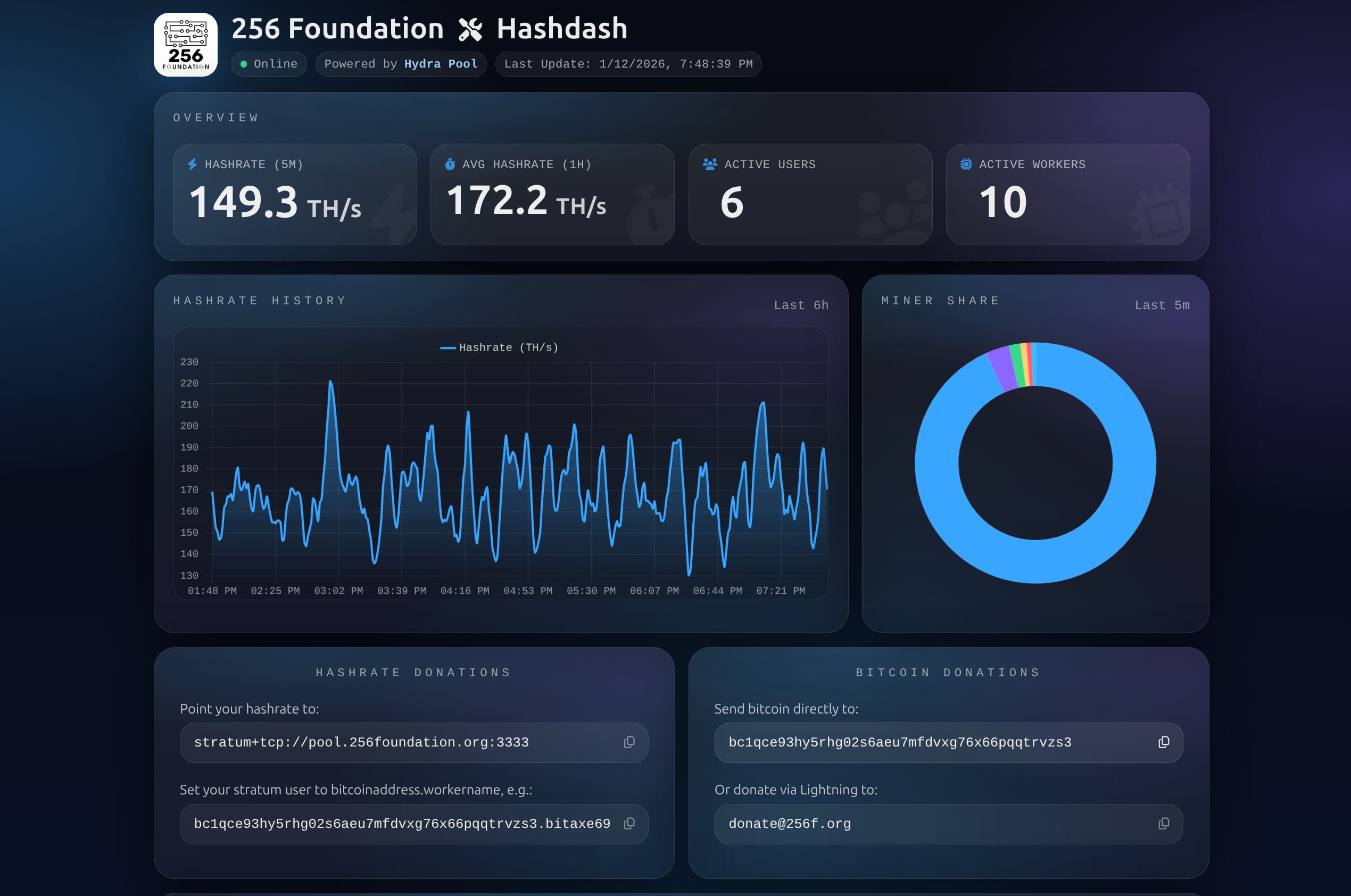
Visualization tools like HashDash and TeleDash address a key pain point in mining: opaque monitoring. HashDash serves as a pool visualizer, rendering metrics like total hash rate, active workers, and share distributions in real-time. TeleDash extends this for fundraiser streams, featuring overlays and a "jumbotron" view with data such as block height, BTC price, donation messages, odds of finding a block, and leaderboards. Built on Prometheus/Grafana stacks, these tools are essential for technical users who need granular insights—e.g., querying time-series data for variance analysis or alerting on dropped connections. In a field where downtime costs rewards, these dashboards enable proactive management, integrating with Nostr npubs for social profiles to build community around mining.
Developer d++ walked through HashDash's interface, suggesting extrapolations like smoothed hash rate curves (using exponential moving averages to filter noise from variable ASIC performance) and best-share displays (tracking shares above target difficulty for luck estimation). TeleDash's real-time overlays imply WebSocket integrations for live updates, potentially using Rust's async crates like Tokio for handling concurrent streams. The jumbotron's inclusion of on-chain/Lightning funds raised extrapolates to blockchain API pulls (e.g., via Electrs or Blockstream APIs), calculating metrics like odds (based on network difficulty and pool hash rate via formula: odds = (network_hash_rate / pool_hash_rate) * 600 seconds per block). Leaderboard ideas point to sorting by contributed hash rate or shares, with potential for gamification via Nostr relays.
These tools imply a future where mining becomes more accessible and engaging, akin to DeFi dashboards. For technical enthusiasts, implications include custom extensions—e.g., integrating ML models (via Rust's TensorFlow bindings) to predict block finds based on historical shares. Broader ecosystem effects: enhanced transparency reduces scam pools (by verifying coinbase outputs), and social integrations like Nostr could spawn mining DAOs for collective bargaining on energy deals. In decentralized setups, this fosters hybrid pools blending solo and shared mining, potentially increasing overall network security by distributing hash rate. For large-scale operators, Grafana's alerting could automate failover to backup pools, minimizing losses from outages, while open-source code invites forks for specialized dashboards (e.g., energy-efficiency tracking via wattage sensors).
Telehash: The Integrated Fundraiser Stream
Telehash is a live fundraiser stream tied to the mining pool, where participants point hash rate to pool.256foundation.org:33303 using a valid BTC address as the username and any vanity workername you choose. For example: bc1qce93hy5rhg02s6aeu7mfdvxg76x66pqqtrvzs3.bitaxe69.
This blends mining with philanthropy, routing rewards to causes like the 256 Foundation. Importance lies in its real-world testing of open stacks: previous Telehash events (e.g., #1 with the Apollo solo pool hitting an exahash and finding block 881423) demonstrate scalability under bursty loads. For technical miners, it provides a playground for tweaking parameters like difficulty units and hash rate smoothing, while integrating Lightning for instant micro-donations.
Extrapolations include user experience enhancements: smoothing visualizations to handle ASIC variance (e.g., using Kalman filters for prediction), displaying best shares for motivation, and leaderboards ranked by effective hash rate (adjusted for luck via variance normalization). The port-specific join (3333) implies Stratum protocol extensions for address validation, preventing invalid submissions. Funds raised via on-chain/Lightning suggest oracle integrations for price feeds, with odds calculated dynamically. Past events extrapolate to handling transient exahash spikes, testing pool resilience against DDoS-like share floods.
Telehash implies a model for community-funded R&D, where miners contribute hash for grants (e.g., $400k allocated to open projects). Broader effects: it normalizes non-custodial fundraising, reducing reliance on VCs and promoting Bitcoin's sovereignty ethos. Technically, enthusiasts could replicate for local meetups, using TeleDash for live demos, fostering education on protocols like Stratum. Implications for decentralization: by attracting small hashers, it dilutes large-pool dominance, potentially increasing Nakamoto coefficient. Long-term, integrations with Nostr could evolve into social mining networks, where npubs link to profiles for collaborative overclocking tips or shared firmware mods.
Open-Sourcing the Entire Bitcoin Mining Ecosystem
The episode's core ethos—open-sourcing hashboards, control boards, firmware, and pools—tackles the "black box" monopoly of vendors like Bitmain. Projects like Mujina firmware (running on Bitaxe Gamma) enable verifiable code, crucial amid regulatory scrutiny (e.g., GrapheneOS pullback from France). For technical users, this means auditable security, reducing risks like backdoors in proprietary firmware.
Extrapolations: community contributions like Home Assistant integrations for Avalons/WhatsMiners imply IoT ecosystems for mining. The 256 Foundation's grants extrapolate to a pipeline: from prototypes (Ember One v5) to developer kits, accelerating iterations via GitHub PRs. Stress-testing to 10k workers suggests Kubernetes deployments for horizontal scaling.
Implications include a fully open stack for "plug-and-play" mining, rivaling proprietary efficiency (e.g., Ember One aiming for S19 parity). Broader: counters hardware shifts to hydro gear, enabling "hand-me-down" repurposing with open firmware. For enthusiasts, this sparks innovation waves—e.g., custom ASICs via FPGA prototyping—boosting network resilience and reducing geopolitical risks.
Industry Rumors and Hardware Shifts
Rumors of Bitmain's S23 air-cooled units and pivot to hydro/data-center gear highlight supply chain vulnerabilities. Open-source counters this by enabling legacy hardware revival, important for miners facing shortages.
Extrapolations: federal probes imply compliance burdens, pushing vendors to specialized gear. "Hand-me-down" hardware suggests market floods of older ASICs, ripe for open firmware upgrades.
Implications: opportunities for efficiency hacks, like water-cooled blocks on S19s. Broader: accelerates decentralization as small miners access affordable gear, potentially shifting hash rate to renewable-heavy regions.
Future Developments: Hardware, Events, and Contributions
Previews of Ember One integrations, Mujina firmware, water-cooled blocks, and Heat Punk Summit underscore sustained R&D. Supporting Samourai via petitions emphasizes freedom tech's role against "toolmaker" targeting.
Extrapolations: early cooling tests imply thermal modeling (e.g., CFD simulations for heat dissipation). NEMS/Telehash #3 on open stacks extrapolate to live demos, inviting code contributions.
Implications: developer kits enable custom builds, fostering a vibrant ecosystem. Broader: events like Heat Punk Summit could standardize open protocols, enhancing interoperability and driving adoption of sustainable mining practices.
Thank you for reading—stay tuned for more technical deep dives. Point your rigs wisely!